
Rollover Is Underway — Now What?
Download the Part 2 Rollover Guide Now!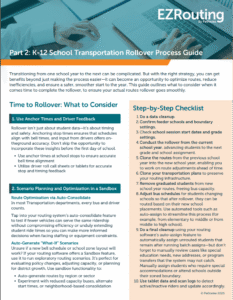
You’ve cleaned your data, confirmed your feeder schools, and backed up your plans. The prep work is done. But the rollover process itself is where strategy meets execution — and where the right decisions can save your district buses, drivers, and hours of rework.
In Part 2 of our K-12 School Transportation Rollover Guide, we focus on what matters most once rollover is in motion: timing accuracy and route optimization.
It starts with anchor times. Aligning your stop schedules to actual bell times is essential for on-time performance on day one. Pair that with real feedback from your drivers — whether through roll call sheets or tablet data — and you get schedules grounded in reality, not just planning assumptions. Drivers see what routing software can’t: the construction zone that adds five minutes, the intersection where a left turn doesn’t work during school hours, the stop where no students have shown up in months.
Then comes the optimization opportunity most districts overlook. If your routing system offers sandbox or auto-consolidate features, rollover is the ideal time to use them. Can you serve the same students with fewer buses? What happens if bell times shift by 15 minutes? What does a zone-based routing model look like compared to your current setup? These are questions you can answer safely in a sandbox — before they become real-world problems.
Whether you’re dealing with staffing shortages, fleet constraints, or district growth, scenario planning during rollover helps you make proactive decisions instead of reactive ones.
This guide walks you through the key considerations step by step, along with tools and services that can make the entire process faster and more accurate.
Download the Part 2 Rollover Guide and turn your rollover from a checkbox into a competitive advantage.