
You’ve Rolled Over Your Routes. Here’s How to Stick the Landing.
Download the Post-Rollover Guide Now!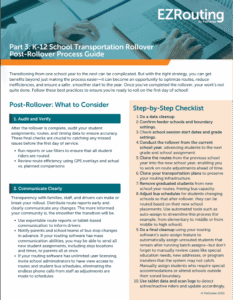
You’ve advanced your students, cloned your routes, and adjusted your schedules. So naturally, you might assume you’re ready for the first day of school.
Not quite. The post-rollover phase is where good transportation departments become great ones. Specifically, it’s the difference between a confident first week and a flood of phone calls from confused parents, frustrated drivers, and overwhelmed school staff.
In Part 3 of our K-12 School Transportation Rollover Guide, we cover the four steps that help you ensure your rollover actually holds up in the real world.
To start, audit and verify. Run reports to confirm you’ve assigned every student rider to a route. Then, use GPS overlays to compare planned routes against actual conditions. This is your last chance to catch gaps before buses hit the road — if you discover an unrouted student on day one, you have a problem. But if you catch it a week before, it’s just a quick fix.
Next, communicate clearly. How you share information with families, drivers, and school staff can make or break your rollout. Send out route information early using mass communication tools, and consider giving school administrators direct view access to schedules. After all, every question a principal can answer on their own is one fewer call your transportation office has to handle.
From there, monitor and adjust. No plan survives first contact with reality perfectly. So in the days and weeks after school starts, compare planned stop times to actual scan data and recalibrate where needed. Your team should treat real ride data from tablets and driver logs as its best tool for fine-tuning.
Finally, clean up your user and vehicle records. Remove inactive drivers, validate bus-driver pairings, and tighten up system access. Although it seems like a small step, it goes a long way toward preventing confusion and strengthening operational security across the board.
Download the Post-Rollover Guide and make sure your team finishes as strong as it started.