
Use your data to optimize your school bus routes and save costs
The first few weeks of school are always a sprint—new routes, late buses, parent calls, and driver call-outs. But once the dust settles, transportation teams have something invaluable: real data.
Those first ridership counts, on-time stats, and route feedback tell the true story of how well your plan worked. This mid-year period is the best time to make smart, targeted improvements—without scrapping your whole system. By learning how to optimize school bus routes and save costs using this real-world data, you’re setting yourself up for success in the second semester. Many districts turn to school bus routing software during this review phase to identify inefficiencies and reduce school transportation costs. Software tools can quickly analyze your operational data and suggest adjustments that would take weeks to calculate manually, helping you enter the spring semester with routes that work smarter, not harder.
Download a copy of the guide now!
1. Rethink Routes Using Actual Ridership
Most districts plan their fall routes in the summer, assuming every eligible student will ride daily. In reality, many buses are only half full when the school year begins. This mismatch wastes fuel, time, and drivers’ patience.
For the second semester, start simple:
- Compare your planned utilization (how full buses should be) to actual ridership (how full they really are).
- Use easy tools like manual headcounts, driver logs, or supervisor notes, to spot patterns.
- Run a short, two-week “ridership audit” to flag underused orovercrowded routes.
Once you have your data in hand, you’re ready to identify the mid-year adjustments that can help to optimize your active routes and make a measurable impact on costs.
2. Fix What’s Feasible, Not Everything
Big overhauls mid-year are disruptive. But targeted fixes? They’re powerful. Bell-time alignment is one of the easiest wins.
If schools allow early arrivals or have longer dismissals, you can shift first-or second-tier routes slightly without changing official schedules.
Many performance issues can be traced back to mismatched bell time data. For example, if a school’s official bell time is 7:30 a.m. but drop-offs are allowed at 7:00, first-tier routes could safely run earlier — freeing capacity for later tiers. If routing software isn’t coded with those buffers, on-time reports will look worse than reality.
Once you’ve mapped the gaps, look for places to consolidate stops, reduce routes, substitute vehicles, or rebalance loads. Just a few adjustments can reclaim hours of route time each week:
Tier and Dismissal Timing:
Elementary schools often stage students for dismissal or prioritize parent pickup first. Adjusting routing tiers to reflect those realities can improve on-time performance, traffic flow, and student safety.
Stop Consolidation:
Even mid-year, there’s room to eliminate redundant stops:
- Stops within one or two blocks of each other
- Outlying stops serving just one or two students
Small changes like these can trim 10–15 minutes per route. When communicating changes, transparency helps. Framing them as reliability improvements — “We’re moving your stop a few blocks to ensure faster, more predictable service.” This builds parent trust.
Vehicle Right-Sizing:
Routes running at less than 25% of planned utilization may be candidates for smaller vehicles or vans. One district freed up capacity system-wide by using small shuttles to move outlying riders to a shared transfer point, enabling larger buses to serve denser neighborhoods.
SPED Route Audits:
After the start-of-year chaos, SPED routes often remain “patched.” Once stable, these can be reviewed for consolidation opportunities or route pairing to improve efficiency without impacting service quality.
Each minor tweak can save minutes, relieve pressure, and boost your on-time rates.
Quick Wins to Try This Month:
- Run a 5-day headcount on half-empty buses
- Identify “dead stops” (no assigned riders)
- Check tier start/end times against real bell time
- Survey drivers for bottlenecks they see daily
3. Let Ridership Data Shape Your Schedule
Once you’ve got accurate counts, use them to inform next semester scheduling.
Ask: Who’s actually riding every day—and who isn’t?
You may find routes that look full on paper but serve only occasional riders. The students of those families can often be moved to shared stops, freeing capacity for daily riders.
Also, consider seasonal changes — students who walk in the fall may rely on buses once winter hits. Build in a modest buffer and plan short “data sprints” throughout the year to stay ahead of shifts.
4. Turn Metrics Into Accountability
After stabilizing routes, ensure your progress remains visible by using clear operational KPIs. The most effective ones are simple:
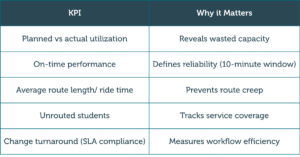
Districts that review their KPIs weekly rather than seasonally spot issues more quickly and communicate more effectively with leadership.
One transportation manager noted, “When you bring data to the conversation, you’re not just explaining problems—you’re providing solutions.”
Once you know who’s actually riding — and how often — you can make more informed scheduling decisions.
Key Principles:
- Audit consistency: A route may appear full on paper but only serve part-time riders.
- Engage families: If students ride infrequently, a shared stop may be acceptable.
- Beware of seasonal shifts: Ridership patterns often spike inwinter as walking students switch to buses. Avoid cutting stops prematurely.
- Build “reinstatement paths”: If you remove a student orstop, establish an easy process for families to rejoin when needed.
- Short-term “ridership sprints” — perform brief, focused audits every few months — keep your data fresh and prevent inefficiencies.
And remember, imperfect data is still actionable. As one expert advised, “Start where your confidence is highest. A week of solid counts beats a year of estimates.”
Common Pitfalls
- Relying on fall semester planning data assumptions rather than post-start data.
- Making permanent cuts before winter ridership stabilizes.
When “fixing” routes, think of them as temporary adjustments and review them later.
Once the system stabilizes, re-evaluate whether each fix still makes sense in the broader context (ridership, bell times, vehicle allocation, etc.).
5. Use the Mid-Year Window Wisely
The quieter months between fall and spring offer a rare chance to step back, review the numbers, and make course corrections.
You don’t need a full system overhaul—just a sharper view of what’s actuallyhappening on the road.
Every small adjustment—removing a stop, shifting a bell tier, or clarifying a KPI—adds up. Together, they create smoother mornings, fewer incoming calls, and more confident leadership decisions.
Want to share this resource with your colleagues? Download a copy of the guide now!